The Addis Ababa University International Humanitarian Law Clinic (AAU IHL Clinic) is excited to announce the launch of the Directory of African Human Rights and Humanitarian Professionals.
At the AAU IHL Clinic, one of our key goals is to serve as a hub for humanitarians, human rights personnel, and others working in or on conflict-affected settings in Africa. This initiative aims to compile a comprehensive database of dedicated individuals working in the fields of human rights, humanitarian assistance, and International Humanitarian Law (IHL) across Africa.
Who Should Register?
We invite African academicians, human rights defenders, humanitarian workers, and other experts engaged in protecting civilians’ rights and promoting human rights, humanitarian law and peace in conflict-affected settings to join this directory. Whether you’re actively working on the ground, conducting research, teaching or advocating for policy changes, your expertise and experiences are invaluable.
Why Register?
Connect with Peers: Join a growing network of African professionals committed to the protection of civilians in conflict-affected settings.
Share Your Work: Showcase your contributions, projects, and achievements to a wider audience.
Collaborate and Grow: Discover opportunities for collaboration, networking, and professional growth.
How to Register:
To be included in the directory, please complete this registration form with your professional details. Your information will help build a comprehensive resource that supports knowledge-sharing and networking among professionals in the field.
We take privacy and confidentiality seriously. Please note that in the form, you can specify what information you wish to make public or keep confidential.
Thank You for Your Support!
We appreciate your participation in this important initiative and look forward to building a vibrant community of professionals working towards a continent safe for its people.
For inquiries, please contact us at ihlclinicaau@gmail.com.
In the first half of 2020, coronavirus, or COVID-19, has spread across the world, destroying lives and devastating livelihoods. Governments and people are delicately balancing concurrent public health, economic and, in some cases, security considerations. Inevitably, restrictions imposed upon business, movement and human interaction will cause further loss. As elsewhere, African States have taken public health measures to prevent and mitigate the effects of the pandemic, including declaring states of emergency and imposing restrictive measures, such as curfews and border closures. For many people, life is at least partially on hold.
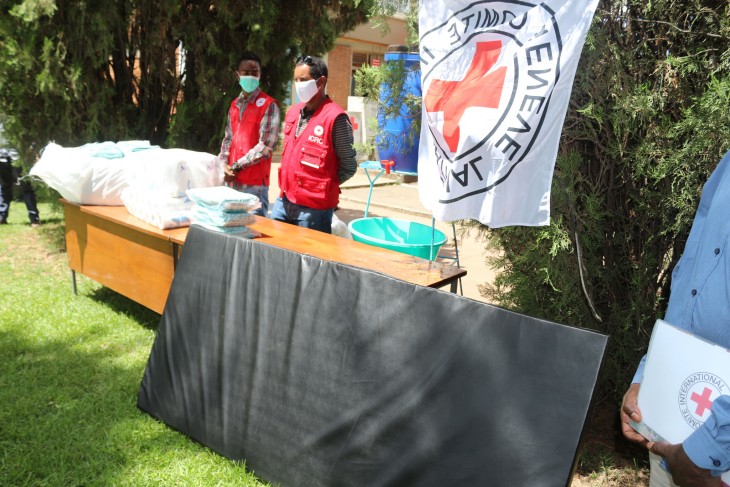
Humanitarian action is also being adapted. In response to the pandemic, the International Committee of the Red Cross (ICRC) has transformed its activities in the East and Horn of Africa. In Ethiopia, it has supplied infection prevention and control items to vulnerable people and promoted health and hygiene. In Kenya, it has worked – together with the Kenyan Red Cross Society and the Kenyan Prison Service – in 48 men’s, women’s and juvenile prisons, to prevent and mitigate the effects of COVID-19. Similar activities have been organized and implemented with urgency across the region and around the world.
At the same time, persistent humanitarian needs that were identified before COVID-19, or that arise concurrently, must be addressed. In addition to its ongoing protection, health, water, habitat, sanitation and other activities, the ICRC continues to work for the promotion of international humanitarian law (IHL). As the guardian of IHL, mandated by the community of States to work for its ‘faithful application’, the ICRC steadfastly pursues the ratification of, accession to and implementation of IHL-related legal instruments. It continues, in the context of its confidential bilateral dialogue, to persuade the parties to armed conflict to abide by their fundamental obligations for the benefit of the victims of armed conflict.
Importantly, IHL requires respect, protection and care for the sick and facilitates the functioning of medical services. It provides a framework for the protection of those who are particularly vulnerable, such as internally displaced persons, migrants – including asylum seekers and refugees – and persons deprived of their liberty. IHL protects items essential to human survival, such as water, and foresees humanitarian access, creating space for impartial humanitarian actors to provide relief to those in need. In sum, IHL provides crucial safeguards during pandemics.
Despite the challenges of the last year, between August 2019 and July 2020, States of the East and Horn of Africa have continued to express their commitment to IHL through concrete action. Following South Sudan’s accession in June 2019, Somalia and Ethiopia have also become party to the African Union Convention for the Protection and Assistance of Internally Displaced Persons in Africa. In doing so, these States celebrate ten years since the adoption of this unique, progressive instrument: the first binding international agreement in respect specifically of internally displaced persons, which, amongst many other things, reflects and recalls IHL.
In the same period, Rwanda finalized its ‘Harmonization Study’: an ambitious and comprehensive account of the country’s participation in IHL-related international legal instruments and their domestic implementation. South Sudan made a voluntary report under the Convention on Cluster Munitions, highlighting measures that it had taken to decontaminate unexploded ordinances. Tanzania became the first State in the East and Horn of Africa to sign the Treaty on the Prohibition of Nuclear Weapons, which binds it to refrain from acts that would defeat the object and purpose of this critical, fundamentally humanitarian treaty.
In December 2019, States and National Red Cross and Red Crescent Societies attended the 33rd International Conference of the Red Cross and Red Crescent, adopting a ‘roadmap for better national implementation of IHL’, which provides a ‘blue-print [for] States’ to ensure that the armed forces, civil servants, parliamentarians, judges and / or National IHL Committees can strengthen the national implementation of IHL. It invites States to, amongst other measures, conduct compatibility studies and adopt appropriate law, ratify / accede to relevant international instruments, integrate IHL into military practice, disseminate IHL and share best practice.
In domestic law too, States of the East and Horn of Africa have also progressed on IHL. National law and other implementation measures are being drafted and discussed, including on the use and protection of the red cross, red crescent and red crystal emblems. IHL has also been considered and incorporated into counter-terrorism laws, protecting impartial humanitarian actors against the risk of sanction for the conduct of their usual, otherwise-lawful activities (For more information on this topic, see International Humanitarian Law and the Challenges of Contemporary Armed Conflicts, Chapter 5).
In 2019, governments, practitioners and scholars were commemorating the 70th Anniversary of the Geneva Conventions: the universally ratified cornerstone of contemporary IHL. This year, focus has turned to the law’s role in the context of complex, multifaceted emergencies. This fundamental change mirrors the rapid evolution of the past 12 months and the urgent re-alignment of priorities at both the national and international levels.
The constant, however, is IHL’s enduring relevance in contemporary armed conflicts: protecting persons not or no-longer taking direct part in hostilities and limiting the means and methods of warfare. Perhaps now more than ever, IHL, robustly and comprehensively implemented, is critical in conflict and pandemic-affected contexts.